

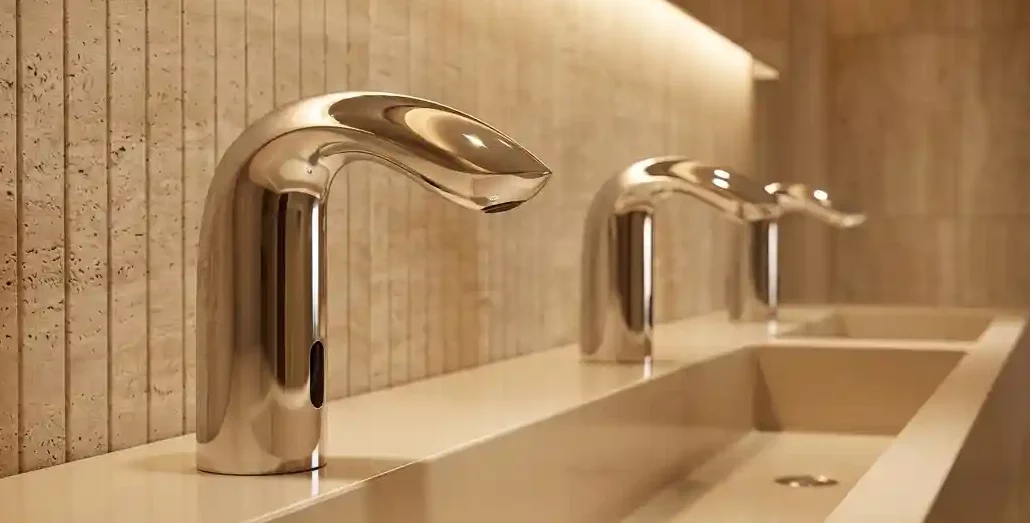
Most sensor taps look the same from the outside. Chrome body, IR sensor, no handle. But walk into a corporate washroom three years after installation, and you will quickly find out that not all sensor taps are built for the same conditions.
The wrong Automatic tap in the wrong environment means constant battery replacements, sluggish sensor response, waterlogged solenoid valves, and a tap that is permanently “on” or permanently “off” during a client visit. Neither is a good look.
This guide is written for facilities managers, admin teams, and procurement leads who are specifying sensor taps for a commercial environment, whether it is a new office fit-out, a hospital washroom, or a retrofit across multiple floors.
How a Sensor Tap Actually Works

An automatic sensor tap has three core components worth understanding before you evaluate options.
**The IR sensor** emits an infrared beam and waits for a reflection. When hands enter the detection zone (typically 5-15cm), the reflected signal triggers the solenoid valve to open. Remove your hands, the reflection stops, the valve closes.
**The solenoid valve** is the workhorse. In high-footfall washrooms, it opens and closes hundreds of times a day. Its quality determines how long the tap lasts before the first service call.
**The power supply** drives everything, and it is the first real decision you need to make. whether to keep the Automatic tap on AC power or alkaline batteries
AC Power vs Battery: The Decision That Matters Most
- Battery-Powered Taps
Battery taps run on 4 AA cells and need no electrical connection at the basin, which makes them easier to install in retrofits.
The limitation is simple: in a high-footfall washroom, a tap opening 300-400 times a day drains a standard alkaline battery set in 6-8 months. Across a corporate washroom serving 200+ employees, that is battery replacements twice a year on every tap. The cost and the effort add up quietly.
Battery taps make sense for lower-footfall locations, executive floors, or retrofits where running power cabling is not practical.
- AC-Powered Taps
Mains-powered taps draw from a transformer under the counter. No batteries, no replacement schedule, consistent power regardless of usage volume. The upfront installation cost is higher because a power supply needs to reach each tap position, but in any new build or planned fit-out, this is straightforward to include.
The rule of thumb – if the washroom serves more than 50 people a day, specify AC. The installation cost difference typically pays for itself within 12-18 months in battery and maintenance savings alone.
Flow Rate and Water Saving

Standard manual taps deliver 8-15 litres per minute at full open. Commercial sensor taps only run while hands are present. A manual tap left running while someone soaps up wastes that entire run time. A sensor tap closes the moment hands move away.
Research from commercial washroom studies suggests sensor taps reduce water consumption by 40-70% compared to standard basin taps in high-footfall environments. For large corporates increasingly tracking sustainability metrics, that is a number worth having on record.
If water efficiency is a specification requirement, ask for taps with a maximum flow rate of 2 litres per minute.
Maintenance and Lifespan
A commercial sensor tap in a high-footfall washroom should last 5-8 years with proper maintenance. Here is what affects that:
**Low water output.** Almost always a clogged inlet filter. Clean or replace it. In hard water cities, this is the single most frequent issue and takes under 20 minutes to fix.
**Water running continuously.** The solenoid valve is stuck open, usually due to a fault in the valve or the electronic circuit. Repair or replace the faulty component. Do not leave it; water waste adds up fast and it will not fix itself.
**No water at all.** Same culprit as above but the opposite failure mode, the solenoid is stuck closed. Check the circuit first, then replace the valve if needed.
**Sensing range inconsistent or too short.** Fault in the electronic circuit. Try adjusting the range manually or via the remote control first. If the problem persists, the sensor module needs replacing.
**Erratic or uneven water spread.** The aerator is blocked or damaged. Clean it first. If cleaning does not fix it, replace the aerator — it is a low-cost part.
**Entire unit dead.** Start with the power supply. For battery models, check the voltage and replace batteries if they are below the required range. For AC models, check the power adapter. Most “the tap is completely dead” calls turn out to be a failed adapter, not a failed tap.
**Battery replacement schedule** (for battery-powered Taps) should be built into a planned maintenance calendar rather than treated as a reactive task. Waiting for taps to fail before replacing batteries means equipment downtime.
What to Ask Before You Buy
Before placing an order for sensor taps , these are the questions worth getting answered in writing:
1. Is the body brass or ABS?
2. AC-powered or battery, and if battery, what is the rated battery life at X actuations per day?
3. What is the detection range, and is it adjustable?
4. What is the warranty period, and what does it cover?
5. Are genuine spare parts available, and what is the typical lead time?
6. Who handles installation and post-installation service?
The last question is worth paying attention to. A supplier who only sells the product and refers you to a separate installer creates an accountability gap. If something goes wrong post-installation, the supplier points at the installer and the installer points at the supplier. Getting supply, installation, and ongoing service from the same team removes that gap.
Frequently Asked Questions
AC-powered taps run off mains electricity via a step-down transformer and need no battery replacements. Battery-powered taps run on 4 AA cells and are easier to install but require battery replacement every 6-12 months in high-use washrooms. For commercial environments with consistent daily footfall, AC-powered taps are the better long-term choice.
Research from commercial washroom studies indicates savings of 40-70% in high-footfall environments. The saving comes from both a controlled flow rate and the fact that the tap closes automatically when hands are removed, eliminating any run-time waste.
This is one of the most common reasons facilities managers end up with a cluttered counter or skip the soap dispenser entirely, and it is a problem that has a straightforward solution. A 2-in-1 automatic tap and soap dispenser combines both into a single unit with one footprint on the counter. The spout and dispenser share one body, one sensor, and one power connection. The soap tank sits neatly under the counter. You get the full touchless handwash experience.